Sustainability: “According to Sustainable Table, more consumers are considering the “environmental, health and social consequences of industrial food production”; as a result, organic acreage is increasing at an annual rate of 15%” (Matthews). The idea of “being sustainable” has become widespread as more and more people become knowledgeable of the effects of human existence on the environment and ultimately, our future. There is more emphasis on qualities such as organic or locally sourced. The denotation of organic is “produced or involving production without the use of chemical fertilizers, pesticides, or other artificial agents” (Oxford) The denotation of locally sourced is “products served and consumed within a 100 to 150 mile radius of where they’re grown” (Oxford) Shoppers called “locavores” are committed to the idea of being part of a community that shares a passion for healthy living and a sustainable environment (Hawkes). This support system has led to a growth and emphasis on shopping locally and creating a “moralized market”-a place in which people combine economic activities and social values (Hawkes). Without the use of chemicals in food products, greenhouse emissions decrease as well as health risks. A study was conducted with salmon to determine exactly how much of a difference organic meal made for the fish, for the consumers, and for the environment (Pelletier). Researchers found that the organic meal created about a 4.3% environmental impact in Canada (Pelletier). This positive number shows that switching to organic does create a difference. Even small-scale changes during such times can eventually show a difference, especially a the amount of consumption of fish increases. It was concluded that the best alternative for fish meals is soy meal. “Canadian-grown soy meal demonstrates consistently better environmental performance than fish meal in all impact categories considered, averaging 30% of the impacts generated by Peruvian fish meal and 44% of those generated by US menhaden fish meal” (Pelletier). With this organic feed, the 4.3% environmental impact previously mentioned would be even greater (Pelletier).
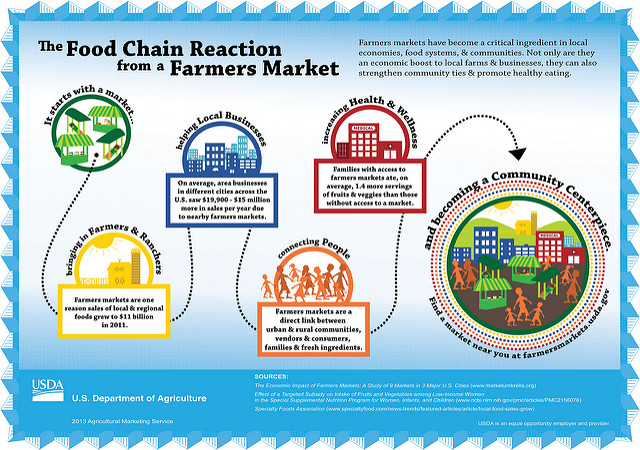
Economy: In 1948, the USDA conducted its first census on farmer’s markets. Surprisingly, there were only six in all of California (White). Since then, there has been over a 150% increase in the amount of farmer’s markets across the United States (Brown, Miller). In West Virginia, a study showed that farmer’s markets contributed to the state’s economy $1.075 million and 43 FTE jobs (Brown, Miller). This contribution includes the loss taken at grocery stores from farmer’s markets. Economy in the business of farmer’s market has increased due to the positive interactions that come with being at the markets (Brown, Miller). Here, the consumers can question exactly how the process of farming is done and consumers can compare products. Farmers become engaged with the consumers, explaining why their product is of the best quality (Henneberry). Farmer’s Markets are the definition of an American free market economy. People freely come and go. People can freely choose which products they’d like to consume. Competition is strong, yet the farmers are still respectable towards each other as they have a common ground. Another aspect to the economical benefits of Farmer’s Markets is the gap between high and low-income Americans (Freedman). This income gap contributes to the food products that consumers buy. One is more likely to buy fresh and not worry about the price of produce when he or she has a higher income, while one is more likely to buy whatever is in the budget when he or she has a lower income. Consequently, the gap in fruit and vegetable consumption increases. “Among studies that included low-income populations (n=19), key barriers to farmers’ market use were perceptions that food assistance benefits were not accepted, belief that food variety at farmers’ markets was limited, lack of access to transportation, lack of racial/ethnic diversity in the market space, and mismatch between markets and personal lifestyles” (Freedman). The lack of inclusion based on income can be fixed by Farmer’s Markets. If low-income families were to be exposed to the truth of the markets with affordable pricing of produce, they are more likely to continue going and create a healthier lifestyle with their body and their wallet.


 The Story of Farmer's Markets